
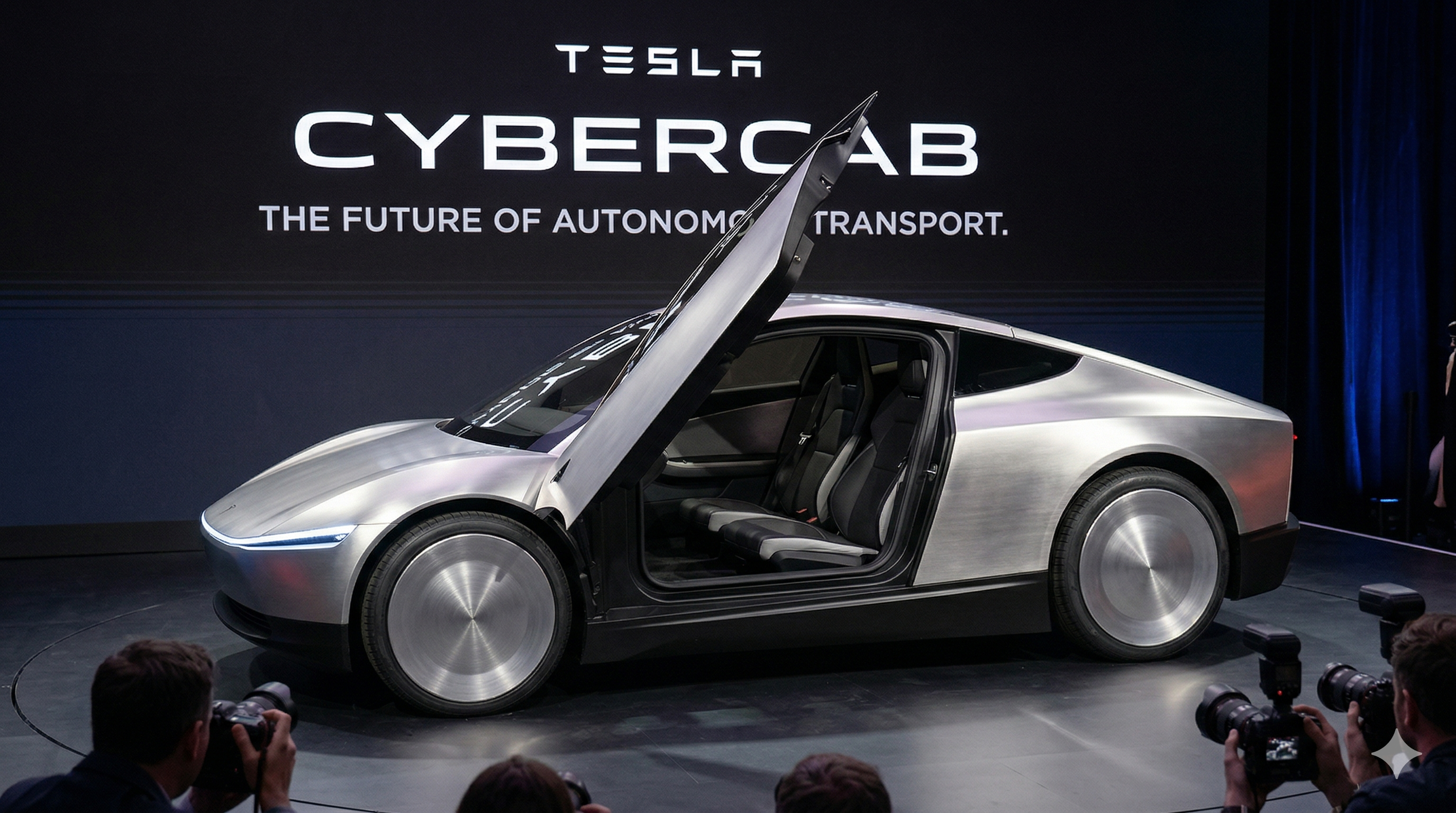
The promise becomes a product
For years, Tesla's robotaxi announcements have been met with skepticism. Elon Musk promised full self-driving "next year" so many times that it became a running joke in the tech community. The jokes are harder to sustain now.
Tesla's Cybercab — a purpose-built autonomous vehicle with no steering wheel and no pedals — is entering mass production in April 2026. It's priced below $30,000 and is designed to operate in a networked robotaxi fleet.
And Tesla has already logged more than 250,000 miles of unsupervised Robotaxi service in Austin, Texas — not with Cybercabs yet, but with existing Model 3 and Model Y vehicles running Full Self-Driving without a human monitor.
The future that seemed perpetually "two years away" is measurably closer than it was.
What the Cybercab actually is
The Cybercab isn't a regular car with self-driving software added. It's been designed from the ground up for autonomous operation:
- No steering wheel or pedals — passengers interact via touchscreen
- Two seats — optimized for urban ride-hailing, not family trips
- Wireless charging — vehicles autonomously navigate to charging spots between rides
- Sub-$30,000 target price — at scale, making the unit economics of fleet operation potentially viable
The fleet will expand from Austin to Miami, Dallas, Phoenix, and Las Vegas through 2026. These are chosen specifically because their relatively flat, grid-based urban layouts are more forgiving for autonomous navigation than places like San Francisco or New York.
Tesla's Full Self-Driving subscription shift
Alongside the Cybercab launch, Tesla made a significant business model change: as of February 14, 2026, FSD is subscription-only at $99/month. The option to purchase it as a one-time package has been eliminated for new buyers.
This is strategically important. Recurring revenue from FSD subscriptions changes Tesla's financial model significantly — turning a one-time sale into ongoing income from millions of vehicles already on the road.
The timing coincides with Cybercab production. As FSD improves through fleet learning, both the subscription product and the Cybercab platform benefit simultaneously.
Waymo: the other player doing it for real
Tesla gets the headlines, but Waymo has been quietly building the most extensive operational robotaxi network in existence.
Waymo currently operates in Austin, the San Francisco Bay Area, Phoenix, Atlanta, and Los Angeles. By the end of 2026, they're targeting expansion to London and Tokyo — the first international deployments. Their stated goal is 20+ cities.
The key difference between Waymo and Tesla's approach: Waymo uses a sensor suite (lidar + cameras + radar) that's more expensive per vehicle but achieves higher reliability in edge cases. Tesla bets entirely on cameras and neural networks, which is cheaper but has historically struggled in low-frequency unusual scenarios.
In practice, both approaches are producing vehicles that operate safely in defined geographic areas. The "which approach wins" debate is still ongoing, but both are past the "will this ever work" question.
What changes when autonomous taxis are real
The implications go beyond convenience. A few that don't get enough attention:
Car ownership in cities. If a reliable robotaxi costs $0.50-$0.80 per mile (Tesla's target), the economics of owning a personal vehicle in an urban area shift dramatically. Urban car ownership is expensive: insurance, parking, depreciation. At those per-mile costs, heavy urban users might simply stop owning cars.
Accessibility. People who can't drive — elderly, visually impaired, those who never got a license — gain independence that current transit systems can't provide.
Drunk driving. Not a revolutionary insight, but: reliable autonomous rides available at 2am eliminate a reason people get behind the wheel when they shouldn't.
Urban space. Cities are designed around parking at a scale that's remarkable when you think about it. Autonomous fleet vehicles that don't park in the city (they cycle to the next pickup) could free enormous amounts of urban land.
The honest caveats
Regulatory approval varies by city and is not guaranteed. A single high-profile accident can trigger political backlash that delays deployment by years. And the economics only work if the technology can scale without human safety monitors — which Tesla and Waymo are betting on but haven't fully proven at fleet scale.
The history of transportation revolutions is full of "the future is here" moments that took much longer than expected to fully manifest. But something is different in 2026: these aren't demos or limited pilots. They're operational services available to the public.
That's a line that matters.